


Osteochondrosis of the neck is a degenerative disease in which literally “premature aging”, “wear and tear” of intervertebral discs, joints, and vertebrae in the cervical spine occurs.
Some facts about the disease:
- Osteochondrosis of the neck occurs in men and women approximately equally often.
- People aged 30-60 years are most often affected.
- As a rule, the pathology occurs in people who at work have to constantly be in one position and make monotonous movements.
- The cervical spine has some structural features, due to which the disease can have many different manifestations.

What features of the cervical spine cause symptoms of osteochondrosis?
- There are openings in the lateral processes of the vertebrae - the carotid arteries, which supply blood to the brain, pass through them to the right and left.
- The initial part of the spinal cord passes through the cervical region - it contains fibers that carry nerve impulses to all parts of the body, provide movement and sensitivity.If the spinal cord is compressed in the neck, neurological disorders occur throughout the body.
- This part of the spinal column has great mobility, and this predisposes to the occurrence of osteochondrosis (although, in most cases, the disease still develops in the lumbar region - it not only has high mobility, but also experiences the greatest stress).
- In the neck area, nerve roots emerge from the intervertebral foramina, forming the cervical and brachial nerve plexuses.They are responsible for movements in the muscles of the neck, arms, shoulder girdle, skin sensitivity, and regulation of autonomic functions.
- The first vertebra does not have a massive front part - a body - it is a bone ring that fits onto the tooth - a bone outgrowth on the second vertebra.Thanks to this, it is possible to turn the head to the sides.
Neck pain, headaches, feeling of weakness, numbness in the hands are symptoms that should make you consult a neurologist.An examination by a specialist and examination using modern equipment will help you understand the causes of the pathology and take the most effective measures.
What happens to the vertebrae with cervical osteochondrosis?
The obscure medical term “degenerative process” refers to the following pathological changes occurring in the cervical spine:
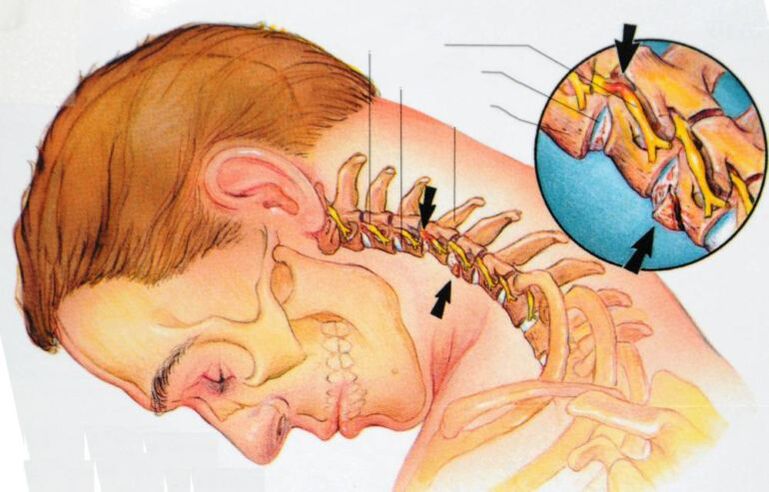
- First of all, damage to osteochondrosis affects the intervertebral discs.They become thinner, thus reducing the distance between adjacent vertebrae.Small tears and microcracks form in their outer parts.Over time, this can lead to a herniated disc.
- As a result of disc damage, the stability of the vertebral connection is disrupted.
- Intervertebral joints also suffer from osteochondrosis of the cervical region - spondyloarthrosis develops.It also contributes to compression of the nerve roots.
- The pathological process extends to the vertebrae themselves.Due to the fact that the functions of the intervertebral discs are disrupted, the load on them increases.The spine tries to compensate for this violation, and bone growths appear on it - osteophytes.
Treatment of osteochondrosis of the cervical spine
During an exacerbation of osteochondrosis of the cervical vertebra, traction is used (the patient is placed on a bed with a raised headboard and the head is fixed using a special loop) to relieve the intervertebral discs.For the same purpose, you need to wear a Shants collar.Painkillers and anti-inflammatory drugs are prescribed to relieve pain.For severe pain that does not go away, the doctor can perform a blockade: inject an anesthetic solution into the area of the affected nerve roots.Physiotherapy is used: ultrasound treatment, electrophoresis with novocaine.
When the exacerbation subsides, treatment of osteochondrosis of the cervical spine involves massage, physical therapy, and physiotherapy.
One of the main signs of cervical osteochondrosis is neck pain.Many people who encounter this symptom do not go to the doctor, but prefer to treat “chondrosis” with home methods.There are at least two good reasons to refuse self-medication and consult a specialist doctor.
Firstly, painkillers and traditional methods, although they help temporarily relieve pain, do not solve the main problem.Pathological changes in the spinal column continue to increase.Over time, this can lead to more serious consequences.To the point where surgery may be required.
Secondly, neck pain occurs not only with osteochondrosis.There are plenty of other reasons.Only a doctor can understand and prescribe the correct treatment.
What symptoms of osteochondrosis of the cervical spine should make you see a doctor?
The main symptom of cervical osteochondrosis is pain.It can occur in different places, depending on the level at which the pathological process is localized: in the neck, in the shoulder girdle, in the arm, in the region of the heart.The pain is dull in nature and can be burning or aching.
Other manifestations of the disease:
- Headaches, dizziness, spots before the eyes, noise, ringing in the ears.
- Weakness in the muscles of the neck, shoulder girdle, and arms.
- Impaired skin sensitivity.
- Humeral periarthritis: aching pain in the neck that spreads to the arm, difficulty abducting the arm above 90°, weakness and atrophy of the shoulder girdle muscles.
- Shoulder-hand syndrome: pain in the shoulder and hand, swelling and stiffness of the fingers, weakness and atrophy of the muscles of the hand.
- Vertebral artery syndrome.Bone growths appear on the vertebrae, which compress the nerves, resulting in a reflex spasm of the vertebral artery, which takes part in the blood supply to the brain.Symptoms of cervical osteochondrosis include constant headaches that start from the back of the head, spread to the temple, to the crown of the head, nausea, noise in the head, ringing in the ears, flickering bright spots before the eyes.
- Anterior scalene syndrome.On the neck there are the anterior and middle scalene muscles - they are nearby, and between them there is a small space in which nerves and blood vessels pass.With osteochondrosis of the cervical spine, the anterior scalene muscle becomes tense and compresses them, resulting in symptoms such as pain on the inner surface of the forearm, shoulder, and fingers.Sometimes the pain radiates to the back of the head.The skin of the hand may become cold, pale, and numbness occurs.
- Epicondylitis syndrome.In the lower part of the shoulder, on the sides of the elbow joint, there are bony protrusions - epicondyles.With epicondylitis syndrome caused by cervical osteochondrosis, pain occurs in them, which intensifies when pressed.Other symptoms also occur: neck pain, pain when pressing certain points in the cervical vertebrae.
If two parts of the spine are affected at once, with cervicothoracic osteochondrosis, symptoms may include pain between the shoulder blades, in the area of the heart.
With osteochondrosis, the risk of intervertebral hernia and stroke increases.If you experience the symptoms listed above, consult your doctor.
It is better not to self-medicate.Even if you have proven methods that usually help cope with pain, this does not mean that you are doing everything right.
Pain can be caused not only by osteochondrosis, but also by intervertebral hernia, muscle disorders (myofascial pain syndrome), and be a symptom of other diseases.In order to properly treat a disease, you need to understand its causes and carry out a differential diagnosis.This is only possible in a clinical setting.
In order to identify the cause of the disease and correctly treat the symptoms of cervical osteochondrosis, you need to visit a neurologist and undergo an examination.
Cervical osteochondrosis is based on damage to the intervertebral discs.Their chemical composition is disrupted, first they swell, then decrease in size, cracks and tears appear in their outer part, and they become denser.Then the degenerative process spreads to the vertebrae and intervertebral joints.By reducing the height of the intervertebral disc, the load on the vertebrae increases, and bone growths – osteophytes – appear on them.
What causes lead to the occurrence of osteochondrosis of the cervical spine?
There is no consensus on the causes of cervical osteochondrosis.It is believed that the disease is caused by different conditions, there are different points of view:
- Age-related changes in the spine.However, almost all people over 40 have skeletal changes, but not everyone develops osteochondrosis.
- Neck injuries.Often the causes of the disease include previous trauma: neck bruise, compression fracture, vertebral subluxation.Chronic injuries may be important, for example, during intense training in athletes, constant work in an awkward position, bent over, and repetitive whiplash injuries in motorists.
- Congenital vertebral anomalies: cervical ribs, fusion of adjacent vertebrae, fusion of the first vertebra with the occipital bone, etc.
- Profession.More often, the disease affects people who work in a monotonous position and constantly make the same type of movements.
- Poor blood supply to the spine, venous insufficiency, swelling in the area of the nerve roots.
- Autoimmune disorders.Conditions in which the immune system does not work properly and attacks the body’s own connective tissue and ligaments.
Visit a neurologist.An experienced specialist will understand the source of your health problems and prescribe the correct treatment.
Causes of exacerbation of cervical osteochondrosis
Osteochondrosis occurs in the form of alternating exacerbations and periods of improvement, when the symptoms cease to bother you for a while.Another exacerbation can be triggered by the following reasons:
- Awkward, sudden movement of the neck.
- Staying in a monotonous uncomfortable position for a long time.For example, your neck may begin to hurt after working on a computer for a long time, or after sleeping on an uncomfortable pillow.
- Stress, nervous tension.With chronic stress, spasms occur in the neck muscles, which can cause another exacerbation.
- Various diseases, exacerbations of chronic diseases.
- Hypothermia.For this reason, many people experience exacerbations in the fall.
- Incorrect, illiterate self-medication.For example, massage and therapeutic exercises are useful during remission, but are contraindicated during an exacerbation.
What diseases can have similar manifestations?
Very often, manifestations of “osteochondrosis” are actually associated with a completely different disease.For example, the cause may be hidden in the muscles - there is a condition called myofascial pain syndrome.Pain occurs due to constant tension in the same muscles.
Sometimes dizziness associated with otolithiasis, a condition in which crystals of calcium salts accumulate in the inner ear, is taken to be a manifestation of “cervical osteochondrosis.”
Pain and crunch in the neck, headaches - when these symptoms occur, many people “diagnose” themselves with osteochondrosis.Everything is clear - when it hurts, you need to take painkillers or get an injection, apply heat, and everything will go away.Why go to the doctor if you can handle it yourself?
However, self-medication often does not lead to anything good.Painful attacks may become more frequent, severe, and prolonged over time.If you uncontrollably take painkillers almost every day, you can get stomach or kidney problems.After all, any medicine has side effects.
And the cause of pain is not always due to osteochondrosis.In order to find out the real reason and understand how to effectively deal with it, you need to visit a doctor and undergo an examination.
How does a neurologist diagnose cervical osteochondrosis?What happens in the doctor's office during an examination?
During your first appointment, the neurologist will ask you some questions:
- How long have you been bothered by headaches or neck pain?
- Where does the pain occur?What is their nature: stabbing, aching, shooting, pulling?
- When does pain usually occur?What triggers it?After what do you feel better?
- Have you already visited a doctor?Have you been examined and treated?Which?How long ago?
- What other symptoms bother you?
- What other chronic diseases do you have?
- Have you recently had a neck injury?
The doctor will then conduct a neurological examination, checking your reflexes, skin sensitivity, muscle strength and tone.You will be asked to turn, tilt your head to the sides, forward, backward.The doctor will press lightly on your head and on certain points in the neck to determine the occurrence of pain.
After the examination, you will be diagnosed and prescribed the necessary diagnostic methods.
What diagnostic methods are used for osteochondrosis of the cervical spine?
Examination for cervical osteochondrosis usually includes the following diagnostic methods:
- X-ray of the cervical spine.
- According to indications, X-ray contrast studies are prescribed: myelography (injection of contrast into the space surrounding the spinal cord), discography (injection of contrast into the intervertebral disc), angiography (injection of contrast into the vessels).
- Computed tomography.
- Magnetic resonance imaging.
- If you have severe neurological disorders, you may be prescribed electroneuromyography, a study that determines the passage of electrical impulses in the nerves and muscles.
Often, manifestations of cervical osteochondrosis resemble angina pectoris.If after the examination the doctor still has doubts about the diagnosis, you will be prescribed an ECG and other diagnostic methods.